AI agents · workflow design · software delivery
Better agent systems begin with a better process.
DG DevTeam is an open-source multi-agent development workflow built around a simple idea: raw token consumption is not the measure of good delivery. Clear stages, explicit handoffs, and intentional parallelism are.
In short: the system plans work before it builds, runs independent coding work in parallel, and uses sequential QA, review, documentation, and release gates to keep the final result accountable. Built by Daryll, AI Engineer | Full Stack Software Engineer.
- execution modes
- 2
- delivery stages
- 5
- shared source of truth
- 1
The primary delivery path
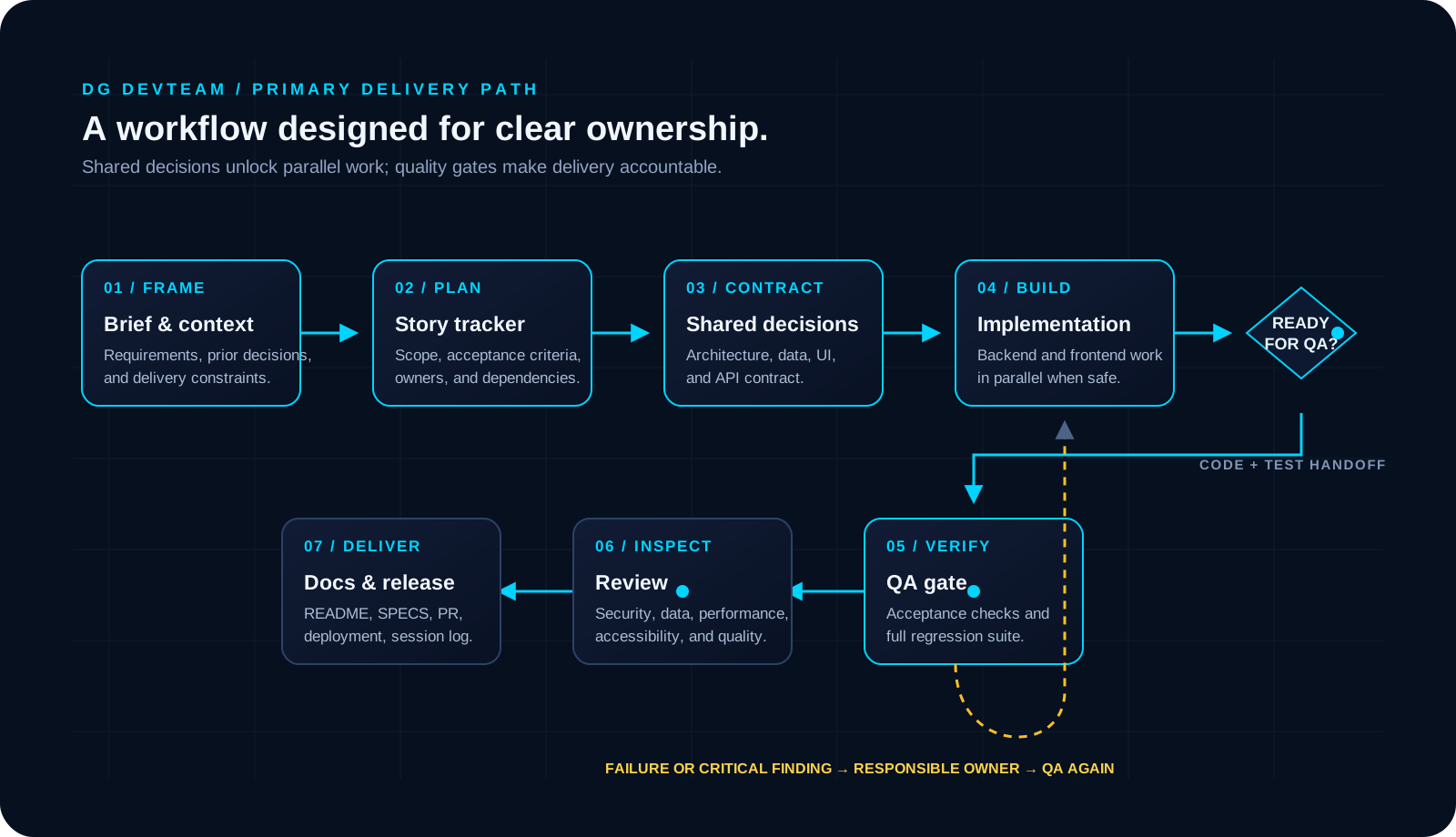
The delivery path makes the handoffs visible: planning establishes shared constraints, implementation fans out only when dependencies allow it, and QA plus review converge the work before documentation and release.
THE CHALLENGE
Agent teams can move fast and still lose the thread.
Without a workflow, an agent team can spend a large budget repeating discovery, making incompatible decisions, or handing off code without a clear definition of done. More parallel activity can make that ambiguity harder to see.
The design question was not how to maximize simultaneous agents. It was how to make every role, dependency, and quality check legible enough that the system could make the right execution choice for the work at hand.
THE WORKFLOW
A workflow that knows when to fan out and when to wait.
Each stage creates an input the next one can trust. This turns agent collaboration from a collection of prompts into an operating system for delivery.
01 / Frame the work Turn a request into an executable contract.
Planning agents translate a product brief into a living story tracker, architecture decisions, API expectations, and UI direction. The implementation team starts from shared constraints rather than a vague prompt.
02 / Map dependencies Choose parallelism deliberately.
The tracker identifies whether a story is backend-first or can run as a parallel group. Independent frontend and backend responsibilities can proceed concurrently; dependent work waits for the decision or contract it needs.
03 / Build with ownership Give each agent a bounded responsibility.
Specialized coding agents work within clear file and feature ownership. Database, backend, and frontend decisions stay connected to the prior planning artifacts instead of becoming isolated implementation guesses.
04 / Prove the result Make quality a gate, not a suggestion.
QA checks acceptance criteria and regression coverage before review agents inspect implementation choices, security, accessibility, and maintainability. Failures return to the responsible stage with a visible trail.
05 / Close the loop Deliver a maintainable handoff.
Documentation, GitHub, and deployment agents complete the delivery path. The outcome is not just changed code: it is a reviewed change set, clear project knowledge, and a traceable record of what was done.
DESIGN DECISIONS
Process design is the performance feature.
Structure before scale
More agents or more tokens do not automatically create a better result. DG DevTeam prioritizes the contracts, dependencies, and decision points that make each subsequent step more reliable.
Parallel when independent
Parallel execution is a scheduling choice, not a default. The workflow fans out only after shared inputs are stable and only where work can proceed without conflicting assumptions.
Sequential where accountability matters
Planning, QA, review, documentation, and release form intentional gates. That sequence prevents unfinished or unverified work from being mistaken for delivery.
THE OUTCOME
An agent team built to deliver clarity alongside code.
DG DevTeam makes the workflow itself inspectable: the work is planned, dependencies are explicit, parallelism is intentional, and downstream quality gates preserve accountability. That makes the team useful not because it can consume more tokens, but because it can make better decisions about the next unit of work.
- A story tracker that exposes status, acceptance criteria, and QA state
- Architecture, API, database, and UI decisions available to the agents who need them
- Parallel implementation only for explicitly independent responsibilities
- QA and review loops that route findings back to the correct owner
- A documented, review-ready delivery path from request through deployment
Built for Codex and Claude Code agent workflows.